특허 및 연구성과
닥터공랩의 성과와 특허를 확인하세요.
[논문] 컴퓨터 도킹 및 인간 신경모세포종 세포에서 실험적 분석을 통한 산화스트레스에 의해 유도된 신경독성에 대한 석류 발효 주스 화합물의 시너지 잠재력 탐색

 다-1-434(2024).pdf (9.3 MB)
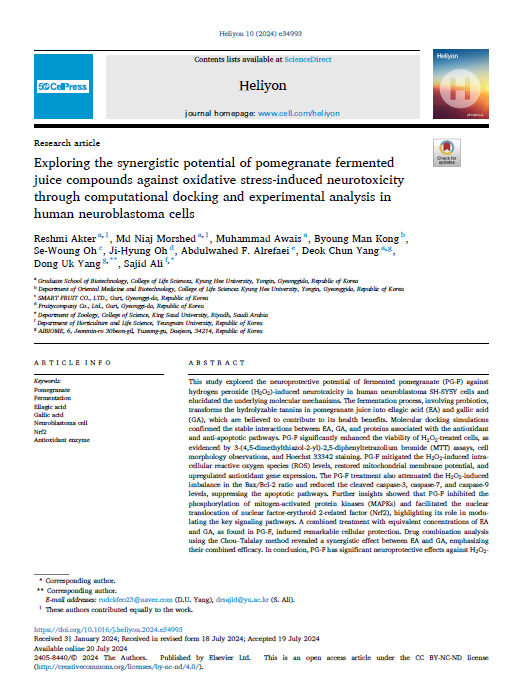
This study explored the neuroprotective potential of fermented pomegranate (PG-F) against hydrogen peroxide (H2O2)-induced neurotoxicity in human neuroblastoma SH-SY5Y cells and elucidated the underlying molecular mechanisms. The fermentation process, involving probiotics, transforms the hydrolyzable tannins in pomegranate juice into ellagic acid (EA) and gallic acid (GA), which are believed to contribute to its health benefits. Molecular docking simulations confirmed the stable interactions between EA, GA, and proteins associated with the antioxidant and anti-apoptotic pathways. PG-F significantly enhanced the viability of H2O2-treated cells, as evidenced by 3-(4,5-dimethylthiazol-2-yl)-2,5-diphenyltetrazolium bromide (MTT) assays, cell morphology observations, and Hoechst 33342 staining. PG-F mitigated the H2O2-induced intracellular reactive oxygen species (ROS) levels, restored mitochondrial membrane potential, and upregulated antioxidant gene expression. The PG-F treatment also attenuated the H2O2-induced imbalance in the Bax/Bcl-2 ratio and reduced the cleaved caspase-3, caspase-7, and caspase-9 levels, suppressing the apoptotic pathways. Further insights showed that PG-F inhibited the phosphorylation of mitogen-activated protein kinases (MAPKs) and facilitated the nuclear translocation of nuclear factor-erythroid 2-related factor (Nrf2), highlighting its role in modulating the key signaling pathways. A combined treatment with equivalent concentrations of EA and GA, as found in PG-F, induced remarkable cellular protection. Drug combination analysis using the Chou–Talalay method revealed a synergistic effect between EA and GA, emphasizing their combined efficacy. In conclusion, PG-F has significant neuroprotective effects against H2O2-induced neurotoxicity by modulating the antioxidant and anti-apoptotic pathways. The synergistic action of EA and GA suggests the therapeutic potential of PG-F in alleviating oxidative stress-associated neurodegenerative diseases.